

What is an ESOP?
- ESOP stands for Employee Stock Ownership Plan and is a type of retirement plan that enables employees to own part or all of the company they work for.
- Individual employees accumulate shares in their retirement accounts over time, and they cash in on those shares when they retire or leave the company.
The Basics
- You earn stock simply by working for the company; there are no out-of-pocket expenses.
- An independent trustee oversees the ESOP, ensuring that it pays a fair price for its stock and that the plan is operated in the best interest of employees.
- The value of stock changes yearly based on the company’s performance.
- Participants receive yearly statements (projected Q3 of the fiscal year) showing allocated shares and their value.
- Employees must meet specific requirements to “vest” in their shares, meaning they earn the right to those shares over time (more below).
Why ESOP
- Everyone is in a position to be successful.
- It is not only beneficial for the company, but also beneficial for our people in the long term.
- The ESOP structure is one of the best forms of capitalism.
- ESOP owners are protected from risk and downside risk, but only get upside through performance.
- If we consistently perform at an average rate, it will have a positive impact on everyone.
- If we consistently perform above average, it could have a life-changing effect on everyone.
Employees automatically enter the ESOP on January 1 or July 1 after meeting eligibility criteria.
- Eligibility includes being 21 years or older and completing a year of service working 1,000 hours or more in 2024, and being employed as of December 31, 2024.
Examples of Participation Based on Hire Date
Eligible to Participate in 2024
- Example A: Assume you are hired on March 1, 2019; you enter the Plan on January 1, 2024.
- Example B: Assume you are hired on March 1, 2024; you enter the Plan on March 1, 2024.
Not Eligible to Participate in 2024
- Example C: Assume you are hired on October 15, 2024; you enter the Plan on January 1, 2026.
- Example D: Assume you are hired on May 1, 2025; you enter the Plan on July 1, 2026.
- Example E: Assume you are hired on August 1, 2025; you enter the Plan on January 1, 2027.
You do not make any contributions to the ESOP. Only the company contributes to the ESOP.
Contributions are generally used as follows:
- To make interest or principal payments when the Trust has an outstanding loan.
- To purchase additional shares on behalf of eligible employees.
- If the company contributes stock shares, those shares will be allocated to eligible employees.
- If contributions aren’t used to pay off a loan or purchase additional shares, they will be placed in your other investments account.
- The Trust uses a loan to buy company stock. These shares go into a special holding account called a “suspense account.”
- Each year, as the loan is paid off, a portion of the shares is taken out of the suspense account and given to eligible employees by adding them to their ESOP accounts.
How Your Contribution Share is Determined
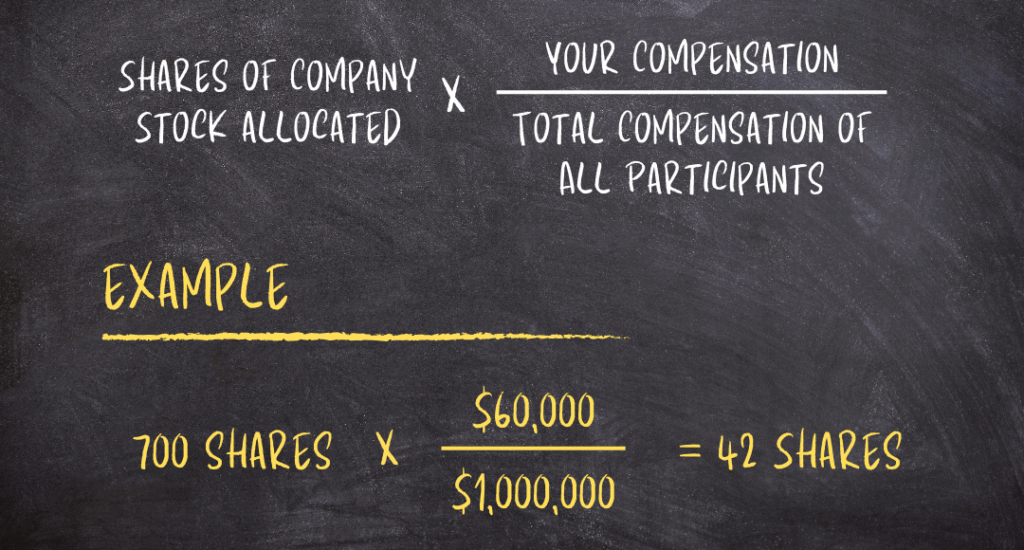
Your share of the ESOP contributions is based on your Annual Compensation compared to the total Compensation of all eligible employees.
- Your compensation includes regular pay, overtime, bonuses, commissions, shift differentials, military differential pay, and pre-tax contributions to retirement or health plans.
- Your compensation does not include reimbursements, expense allowances, fringe benefits, moving expenses, deferred compensation, welfare benefits, or any pay received before joining the ESOP.
Understanding Vesting
Vesting refers to the amount of time an employee must work before acquiring a nonforfeitable entitlement.
A nonforfeitable entitlement refers to a benefit that a participant has earned and is legally guaranteed to receive.
- Vesting begins following your date of hire and during a calendar year in which you have completed at least 1,000 hours of service with the company.
Vesting Schedule
Terminations and Early Retirement
- If you leave the company before becoming fully vested (100%), you will lose (forfeit) any unvested portion of your account.
- Forfeitures will be used to pay administrative expenses, reduce the company contributions required for that year, or allocated to participants.
- If you retire before retirement age, you will retain the vested portion and eventually receive retirement benefits.
What Happens If You're Rehired?
- If you’re rehired before having five years in a row without working for the company:
- You rejoin the ESOP.
- Your previous years of service count again.
- Any unvested shares you lost may be restored.
- You could earn full ownership of those shares if you work for more years and repay any money you received from your ESOP upon leaving.
- If you’re rehired after five consecutive years away:
- You lose your unvested shares permanently.
- Your past service years also no longer count.
Once you join the ESOP, two separate accounts are created for you:
1. COMPANY STOCK ACCOUNT
Holds allocated shares
- This account holds the shares of Company Stock allocated to you each year.
- These shares come from the ESOP’s suspense account and are distributed based on your eligibility and participation.
2. OTHER INVESTMENTS ACCOUNT
Holds other assets or reshuffled stock
- This account holds your share of any cash contributions made by the Company that aren’t used to buy more Company Stock or repay ESOP loans.
- If you leave the company, the value of your Company Stock may be moved into this account, as part of a process called “reshuffling.”
After each Plan Year (which ends on December 31), you’ll receive a statement showing:
- Your account balances
- Contributions made by the Company
- Dividends and other credited amounts
This statement is sent annually, following the ESOP appraiser’s determination of the Company Stock value.
F.A.Q
Are There Limits on How Much Can Be Allocated to My Account?
Yes. Federal law sets limits on how much can be added to your retirement accounts each year, including:
- Your ESOP accounts
- Any 401(k) or other retirement plans offered by the Company
The maximum is the lesser of $69,000 or 100% of your pay.
This limit does not include:
- Catch-up contributions (for those age 50+)
- Investment earnings in your accounts
If these limits affect your ESOP allocations, the Company will notify you.
Will I Receive the Actual Shares in My ESOP Account?
No. The shares are held in trust for you until your retirement benefits are distributed.
Each year, you’ll get a statement showing:
- The number of shares credited to your account
- That these shares are held in the ESOP Trust for your benefit
Getting Your Benefits
You receive benefits:
- When you retire (at age 65),
- If you become disabled or pass away,
- If you leave the company for any other reason
Distribution types:
- Installments (up to 5 years) if your account is over $7,000
- Lump sum or rollover to IRA if under $7,000
Your Normal Retirement Date is when you turn 65. If you retire at or after this age, you’ll be fully vested in your ESOP account, meaning you’ll receive all the benefits you’ve earned.
You can keep working after age 65 and still participate in the ESOP, as long as you continue to meet the eligibility requirements.
F.A.Q.
When do I get my ESOP money?
- Benefits can typically be received one year after retirement.
Will my ESOP account earn interest?
- Gains or losses in the ESOP account are due to changes in stock value, not interest.
Can I borrow from or against my ESOP?
- Borrowing from the ESOP account is not permitted; funds are intended solely for retirement or separation purposes.
Will I have to pay additional taxes?
- No taxes are due while benefits remain in the ESOP account; distributions may be taxable.